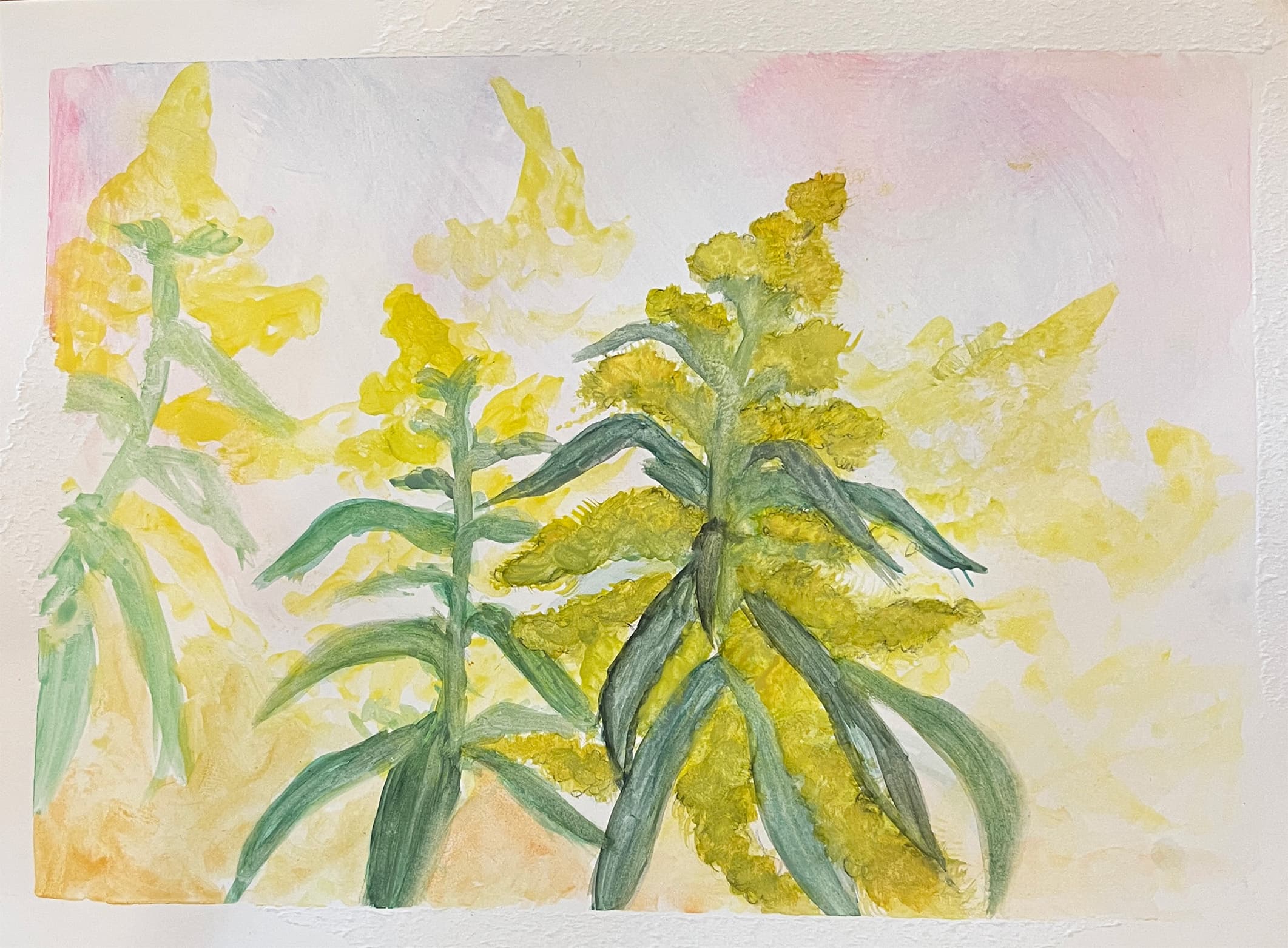
Summer goodbye, I’ll try not to cry.
I’m not a fan of cold weather, especially damp and cold, although we needed this gentle rain.
The herb of the week, Goldenrod, reminds me of my most beloved friendships; how they ripen, how they bend gently under the weight of maturity.
Goldenrod, or Solidago canadensis; its golden rays catch the last warmth of the sun, highlighting summer’s last glow before the quiet of winter, a cornucopia of love, an offering from the earth. This is the season of abundance, of gathering what nourishes us before we turn inward. The bees know it too. Goldenrod is their final feast, their last bloom before the long rest.
Paracelsus and Dioscorides are both attributed with the biomedical concept of plants resembling or having patterns that correspond to the areas in the body where that plant has an affinity. Although this way of recognizing plants is more intuitive and imaginative, goldenrod shines as an example of what herbalists call this “doctrine of signatures.”
It’s strong, upright, resilient, glowing.
Have you ever seen anyone overworked? I’m certain we’ve all been there, bending painfully, back aching at the end of a long day. This can indicate that the adrenals, located above the kidneys, are overtaxed. This person might even cup their hands around their lower back for a little support.
Can you imagine how this person could benefit from a therapeutic, golden rod of light running up the spine, relieving some of the burdens of the day? That’s what goldenrod offers us, giving warmth to the kidneys and adrenals. It has mild diuretic action, so be sure to stay hydrated when using. Aside from this there are no known contraindications.
I’ve often wondered if the sun ripened, lustrous glow of goldenrod works through a similar mechanism as sunlight. Sunlight, specifically sungazing, makes me feel calm, benefitting the hypothalamic-pituitary-adrenal (HPA) axis by encouraging healthy mitochondrial function and hormonal regulatory actions controlled by these three glands. I experience a similar calm when gazing at a field of goldenrod.
Rosemary Gladstar suggests using goldenrod as a sustainable alternative to pipsissewa, a plant that, in her words, “resents domestication and continually frustrates human insistence that it get with the renewable-growing program.” Pipsissewa isn’t easily propagated outside of its natural environment. Goldenrod, by contrast, grows abundantly and generously almost anywhere.
Pam Montgomery also shares a beautiful story in Plant Spirit Healing about an apprentice sitting outside on a “cold, rainy day, feeling agitated and stretched to their limits,” by the weather, not Pam. Then, they looked up and saw goldenrod spread across the field “like the bright shine of a highlighter pen.” That moment of connection helped them refocus and find peace.
I make goldenrod tincture using the “simpler’s method,” a folk approach to herbalism that uses parts instead of precise measurements. I harvest goldenrod as the rods begin to bend and the flowers are heavy with pollen; when the bees’ fuzzy legs are dusted orange, that’s the moment. This year’s harvest has passed, but next year you can be ready.
In the meantime, dried goldenrod flowers are available from local apothecaries like Lancaster Farmacy, in Lancaster, PA https://www.lancasterfarmacy.com/ or mail order from Mountain Rose Herbs https://mountainroseherbs.com/ and can be used to make a tea, or tincture.
This year, I gathered goldenrod at Jade Family Farm in Juniata County, PA. My children and I ended the day with my heart full of love, and arms carrying oodles of kiwi berries, peppers, Asian pears, plus a few gallons of goldenrod flowers ready for tincturing. I filled my gallon glass jars with fresh flowers and added three parts food grade, organic vegetable-grade glycerin to one part quality spring water. Glycerin is a natural preservative and extracts goldenrod’s beneficial compounds beautifully.

Most folks wouldn’t need to prepare this much tincture of goldenrod so if you are going to experiment with it, try much less, like a quart jar. Fill the jar with goldenrod flowers, loosely packed, and fill ¾ of the way with organic food grade glycerin and top off with spring water. You can create an alcohol tincture too, Rosemary and other prolific herbalists have tutorials on this.
My kids and I use this liberally for sore throats and at the onset of colds and flus, so I’ve become accustomed to preparing it with glycerin instead of alcohol. At the first sign of a sore throat our family gargles a few teaspoons of glycerite tincture, then swallows. I gave a bottle to my daughter’s teacher, who could hardly speak, without much expectation. Her teacher called me the next day, much improved. That was ten years ago. Since then, harvesting goldenrod with my family has become a yearly event.
You could also do a combination of alcohol and glycerin which would give you a more potent extraction and a longer shelf life. The simpler’s method of this would be 3 parts glycerin to one-part 40proof or higher alcohol.
Watch a short video about it here.
It’s worth noting that goldenrod often gets blamed for seasonal allergies, but its pollen is too heavy to become airborne. The real culprit is usually ragweed mistaken for goldenrod in the spring. Goldenrod is innocent, and deeply helpful. It is often underrated and underused by herbalists, so I encourage you to lean into this gentle and generous plant.
I hope this vision of golden abundance — free medicine at your fingertips, glowing in the last light of summer — warms your heart as we head into the darker months. May goldenrod be more than a plant: an outer vision of the inner glow we carry, a reminder of strength, friendship, and the warmth that lives within us as we head toward winter.
Works Cited
- Gladstar, Rosemary, and Pamela Hirsch, editors. Planting the Future: Saving Our Medicinal Herbs. Healing Arts Press, 2000. ISBN: 978-0892818945.
Available from United Plant Savers - Maier, Kat. Energetic Herbalism: A Guide to Sacred Plant Traditions. Foreword by Rosemary Gladstar. Chelsea Green Publishing, 2021.
Foreword excerpt via HerbalGram - Montgomery, Pam. Plant Spirit Healing: A Guide to Working with Plant Consciousness. Bear & Company, 2008. ISBN: 978-1591430773.
Available from Bear & Company
Leave a Reply